Suwon Hwaseong Fortress & Haengnidan-gil: Joseon Ramparts, Brick Cafes & Charcoal Galbi (1–2 Days)
30 minutes by KTX (or 40 minutes via Line 1 express train) from Seoul—walk 5.74 kilometers of 18th-century granite and kiln-brick battlements built by King Jeongjo, explore 1970s red-brick alleys in Haengnidan-gil, and dine on oak-grilled Wang-galbi—with a complete Day 1 & Day 2 route.
Field Warnings & Critical Traps to Avoid
Transit connections, seasonal operating restrictions, and on-site etiquette reminders.
Steep Granite Steps on Mount Paldal Ramparts
The western climb from Hwaseomun Gate up to Seojangdae Command Post on Mount Paldal consists of steep, uneven granite steps exposed to sun and morning dew. Wear shoes with solid grip and carry water in summer.
Weekend Galbi Queues vs. Sunset Cafe Timing Conflict
Heritage Wang-galbi halls near Paldalmun and Yeonmudae see 60-minute queues between 18:30 and 20:00 on weekends. Join the queue remotely via the CatchTable app around 17:00 before grabbing sunset coffee, or dine early at 17:15 and stroll lit fortress gates afterward.
Night Illumination Cutoff & Trolley Schedule
Rampart and gate floodlights switch on at dusk and stay lit until 23:00, with deepest sky contrast 20 to 40 minutes after sunset. Note that since March 2024 the Hwaseong Tourist Trolley (6,000 KRW) operates solely on a circular loop departing Yeonmudae, is closed on Mondays, and wraps up before dusk.
Thirty minutes south of Seoul Station by KTX—or forty minutes on Subway Line 1 Express—the dense urban concrete gives way to the five-point-seven-four-kilometer perimeter of Suwon Hwaseong Fortress. Built between 1794 and 1796 by Joseon King Jeongjo to honor his late father Crown Prince Sado and anchor a Silhak reform capital, this UNESCO World Heritage wall integrates granite ramparts, kiln-fired gray bricks, and everyday neighborhood life into a practical one-to-two-day itinerary.
Why This Circuit Pairs Military Masonry, Red-Brick Cafes & Beef Ribs
Everything in old Suwon still loops back to King Jeongjo’s 18th-century city plan:
- North-to-East Ramparts for Engineering & Timber Craft: Starting at Janganmun North Gate’s semi-circular brick barbican, walking south through Hwaseong Haenggung Palace (2,000 KRW; 3-site pass 4,000 KRW), and continuing northeast past Banghwasuryujeong Pavilion to cylindrical Dongbuk Gongsimdon captures the cleanest masonry details without brutal mountain climbs.
- UNESCO Height Caps Froze Haengnidan-gil in the 1970s: Because strict heritage rules ban high-rise redevelopment inside the walls, developers skipped these blocks for decades—preserving two-story red-brick residential lanes that young coffee roasters and ceramic studios have since claimed for rooftop sunset views.
- Agricultural Oxen Created Wang-Galbi: To populate the new fortress city, Jeongjo issued cattle to local farmers, turning Suwon into one of Korea’s top livestock markets. By the 1940s, restaurants beside Paldalmun Market began grilling huge butterfly-cut short ribs over oak embers on hand-woven copper grates.
Extending Your Trip: The Complete Day 2 Morning Route
While Day 1 covers the five core timeline stops from Janganmun to nighttime Paldalmun, staying overnight unlocks the steeper southern ridge and local institutions without rushing:
- 08:30–10:30 · Dawn Ascent to Seojangdae Command Post (Mount Paldal): Tackle the steepest stone stairs on the western wall early before sun and heat build up; the summit pavilion frames the symmetrical palace compound straight below.
- 10:45–12:00 · Archery at Yeonmudae, Tourist Trolley & Flying Suwon: Head back toward the eastern training grounds to shoot traditional Korean bows (3,000 KRW / 10 arrows), ride the dragon-headed Hwaseong Tourist Trolley loop departing Yeonmudae (6,000 KRW, closed Mondays), or check wind conditions for the Flying Suwon tethered helium balloon (20,000 KRW, rising 150 meters above the ramparts).
- 12:15–13:30 · Lunch on Suwon Chicken Street: Walk beside the Suwoncheon stream near Paldalmun for crisp whole-cauldron fried chicken—including the sweet savory Wang-galbi glazed chicken popularized by the film Extreme Job (18,000–22,000 KRW per person, solo-friendly).
- 14:00 · Collect Bags & Return to Seoul: Retrieve stored luggage from Haenggung Tourist Information Center or Suwon Station’s B1 lockers and catch the 30-minute KTX or 40-minute Line 1 Express back to central Seoul.
Step-by-Step Visual Route & Timestamps
Follow our exact on-the-ground walking pace and timestamps. Click any photo or stop title to open rich multi-photo galleries, field tips, and expanded logistical guides.
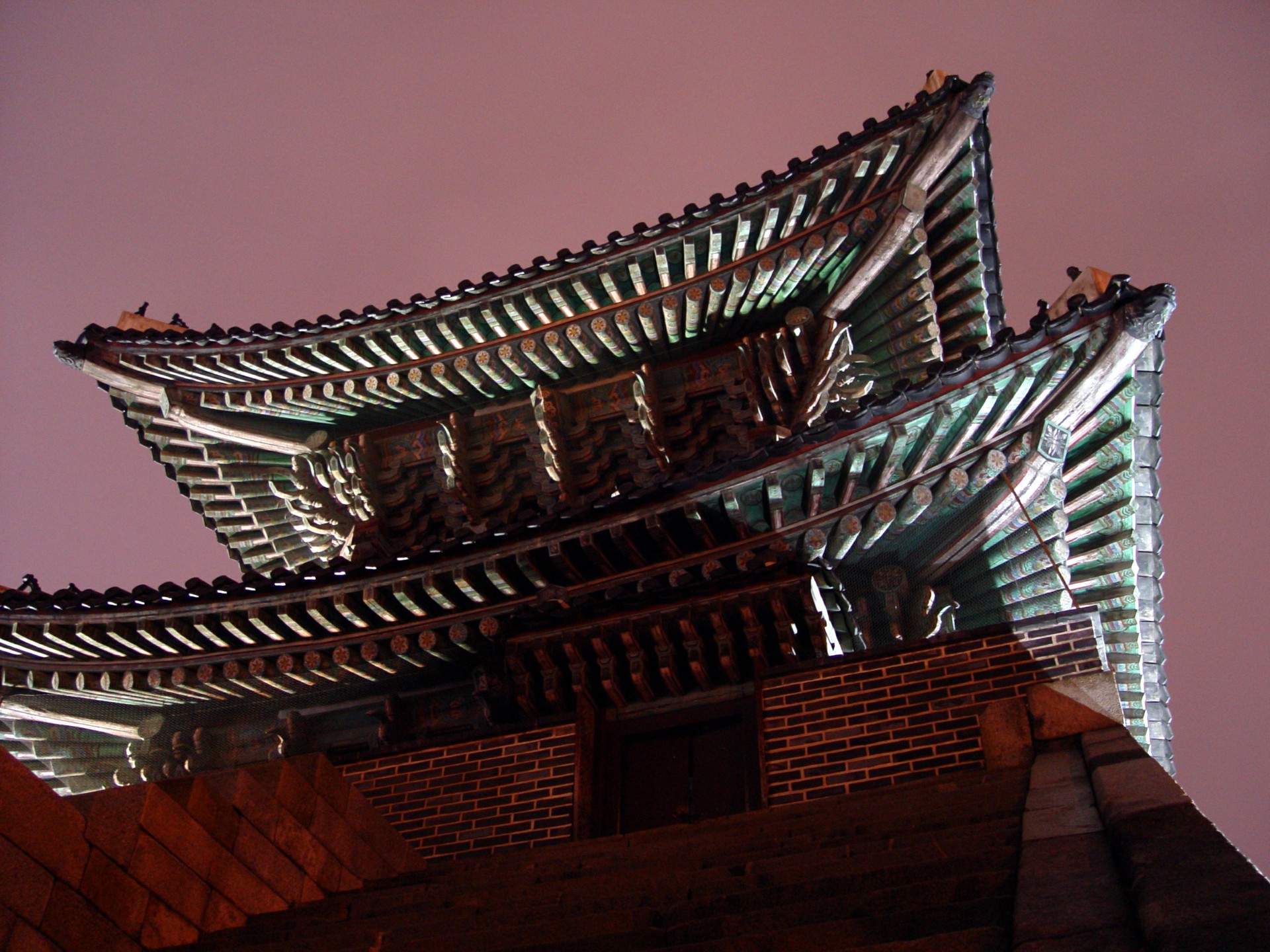
Upward twilight view from stone rampart steps toward Janganmun Gate’s double-tiered dancheong eaves and kiln-fired gray brick parapet. · Photo: Jpbarrass (Public Domain)
Stepping off the bus at Janganmun, the sheer bulk of Suwon’s northern main gate immediately outscales Seoul’s Sungnyemun. Built in 1794 under King Jeongjo—who paid skilled artisans fair piecework wages and adopted polymath Jeong Yak-yong’s pulley cranes—the gate anchors a 5.74-kilometer fortress completed in under three years. Climb the stone steps to the upper brick parapet to inspect the painted dancheong eaves and look out over the curving gray-brick ongseong barbican flying black northern banners, a pocket designed to trap attackers in crossfire above the vaulted granite arch.
View Author’s Original Field Note
親眼站在長安門石拱門底下才發現它比首爾崇禮門還要高大!走上城台沿著半圓形灰黑磚牆繞一圈,射擊孔與瞭望口的角度設計得很精細,站在屋檐陰影下看黑旗飄動很有臨場感。
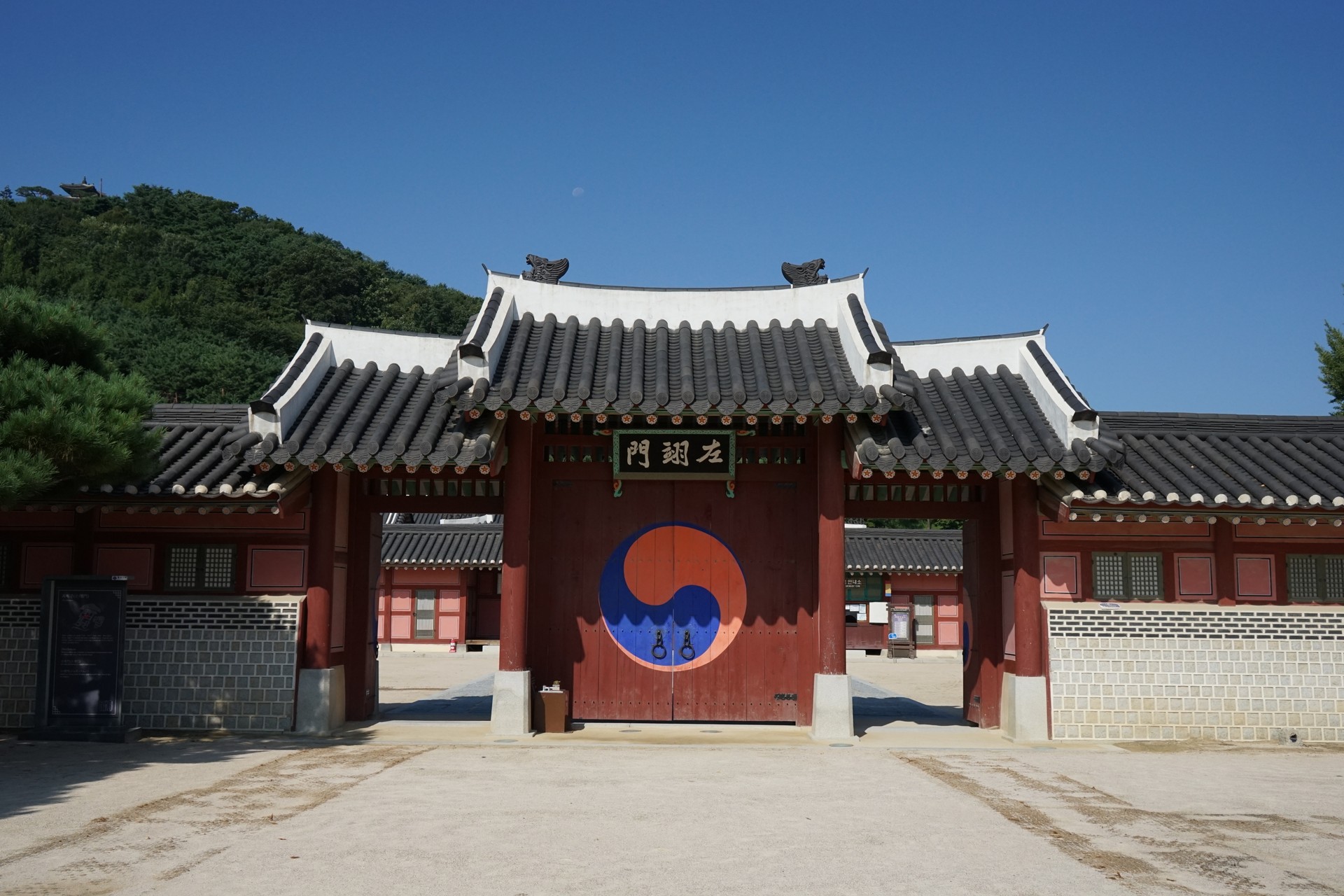
Front symmetry of Jwaikmun Gate inside Hwaseong Haenggung Palace with vermilion Taegeuk wooden doors and Mount Paldal’s summit pavilion behind. · Photo: De-Shao Liu (CC BY-SA 4.0)
Walking eight minutes south from Janganmun brings you past Sinpungnu Pavilion into Hwaseong Haenggung, the largest royal temporary palace of the Joseon Dynasty. King Jeongjo used these 576 rooms as an operational base during filial pilgrimages to his father’s tomb and hosted his mother’s historic 60th birthday banquet here in 1795. Step through the vermilion Jwaikmun gate marked with bright orange-and-blue Taegeuk swirls, then take ten minutes to climb the pine slope directly behind the complex: looking back down, rows of black hanok roofs, walled red corridors, and ancient courtyard trees sit right beside modern Suwon across the plaza.
View Author’s Original Field Note
比景福宮安靜非常多!特別喜歡走上行宮後方的山坡往回看,層層疊疊的黑瓦屋頂、紅牆院落跟外頭的現代街道直接框在同一個畫面裡,比在平地看更有立體感。
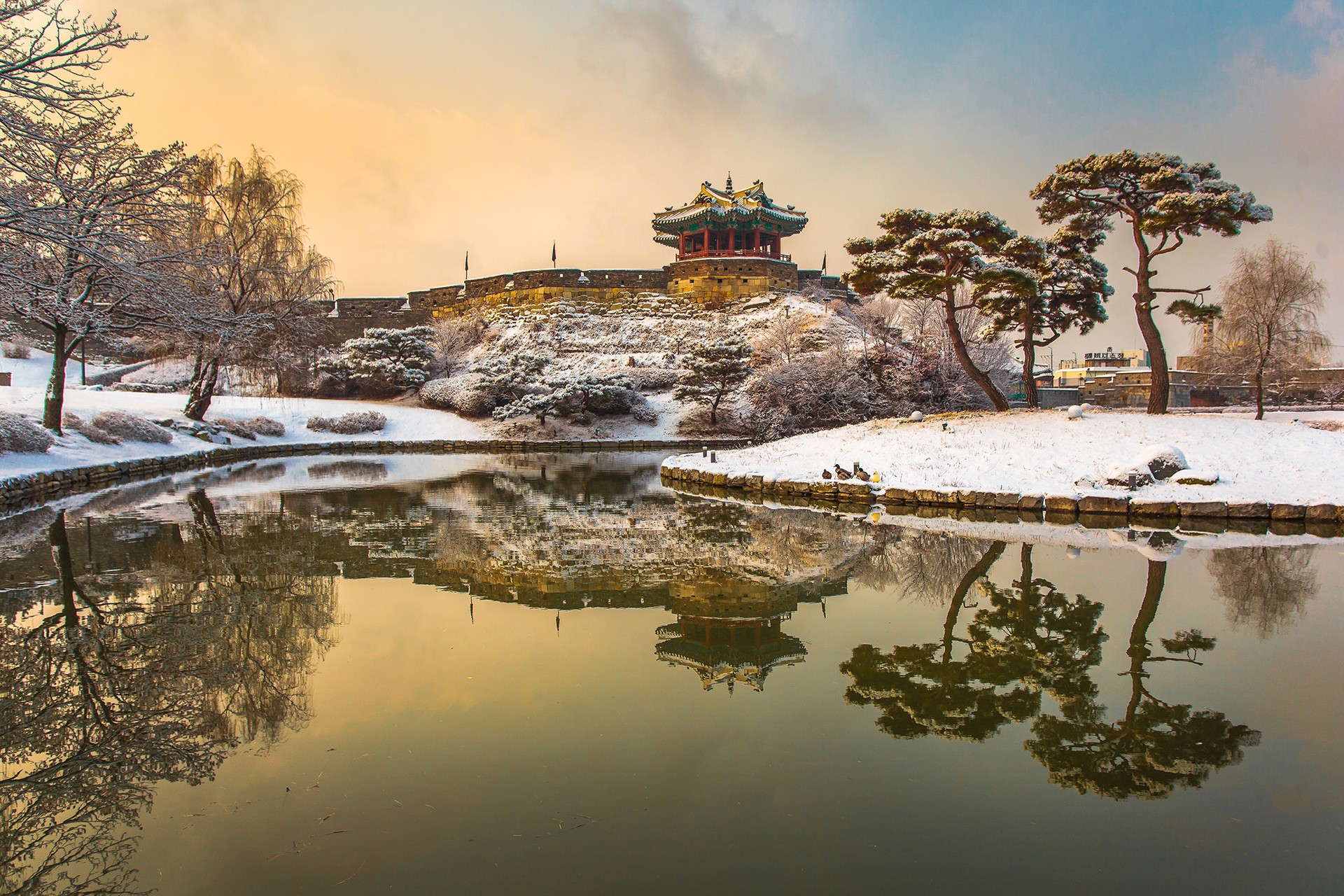
Snow-dusted Banghwasuryujeong Pavilion and old pine trees reflected across calm Yongyeon Pond under late-afternoon golden light. · Photo: Seungh (CC BY-SA 4.0)
Twelve minutes northeast of the palace along the Suwoncheon stream, Banghwasuryujeong Pavilion rises directly atop a rocky granite outcrop. Designated Korea Treasure No. 1709, this 1794 Northeast Corner Pavilion cleverly fuses military surveillance with garden architecture through an asymmetrical cross-shaped hip-and-gable roof overlooking oval Yongyeon Pond—which simultaneously served as an emergency water reservoir. Whether viewed across the calm pond lined by snow-dusted pines in winter or lush weeping willows in summer, climb the curving brick battlements onto the timber platform (shoes off) and look straight up: its open-rafter ceiling exposes every teal-green beam and lotus dancheong bracket overhead.
View Author’s Original Field Note
這座亭子最讓我驚豔的其實是抬頭看屋頂裡面!沒有做平頂天花板,一整排青綠色圓木椽與朱紅大樑的彩繪細節一清二楚,坐在木地板上吹風看龍淵池完全不想起身。
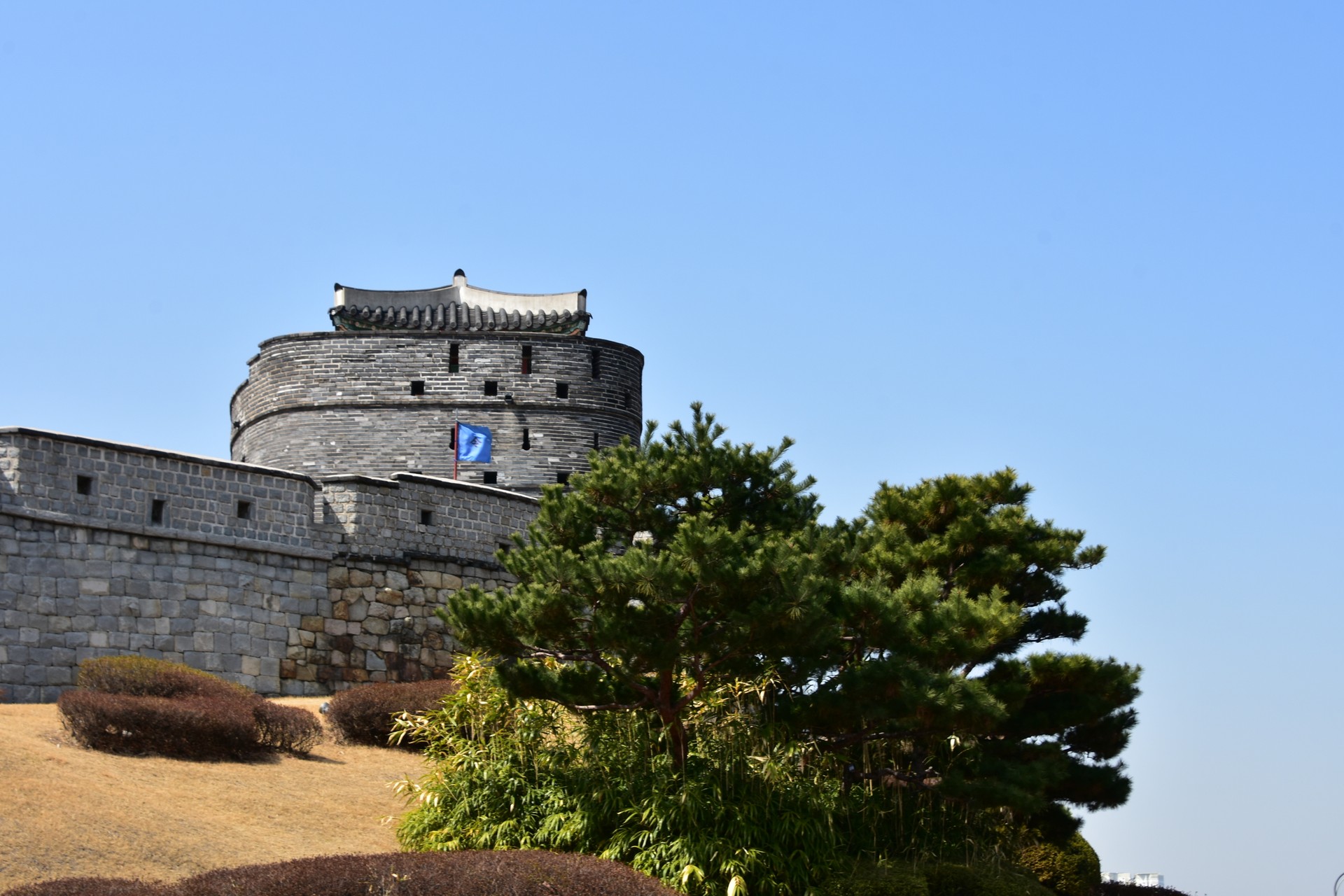
Cylindrical gray-brick Dongbuk Gongsimdon watchtower crowned by a tiled pavilion rising above eastern granite walls and blue eastern flags. · Photo: Richard Mortel (CC BY 2.0)
Follow the smooth earthen trail east along the battlements for five minutes to reach Dongbuk Gongsimdon—a rare cylindrical gray-brick watchtower crowned by a miniature tiled pavilion and nicknamed the “Conch Shell Tower” for its spiral interior brick staircase. Built to defend the open eastern plain, the adjoining rectangular granite Chiseong bastion features three deep vertical stone chutes (hyeonan) designed to pour oil or drop stones onto attackers clinging to the base. As evening approaches, step down off the wall into Haengnidan-gil inside the fortress: strict UNESCO height limits inadvertently preserved its 1970s two-story red-brick homes, now converted into cozy specialty coffee roasters and sunset rooftop terraces.
View Author’s Original Field Note
當地人叫東北空心墩「海螺塔」,近看整座圓筒黑磚牆與層層射擊孔非常特別!這段東側城牆平整又開闊,散完步剛好下切進城內的紅磚巷弄找間咖啡店坐到太陽下山。
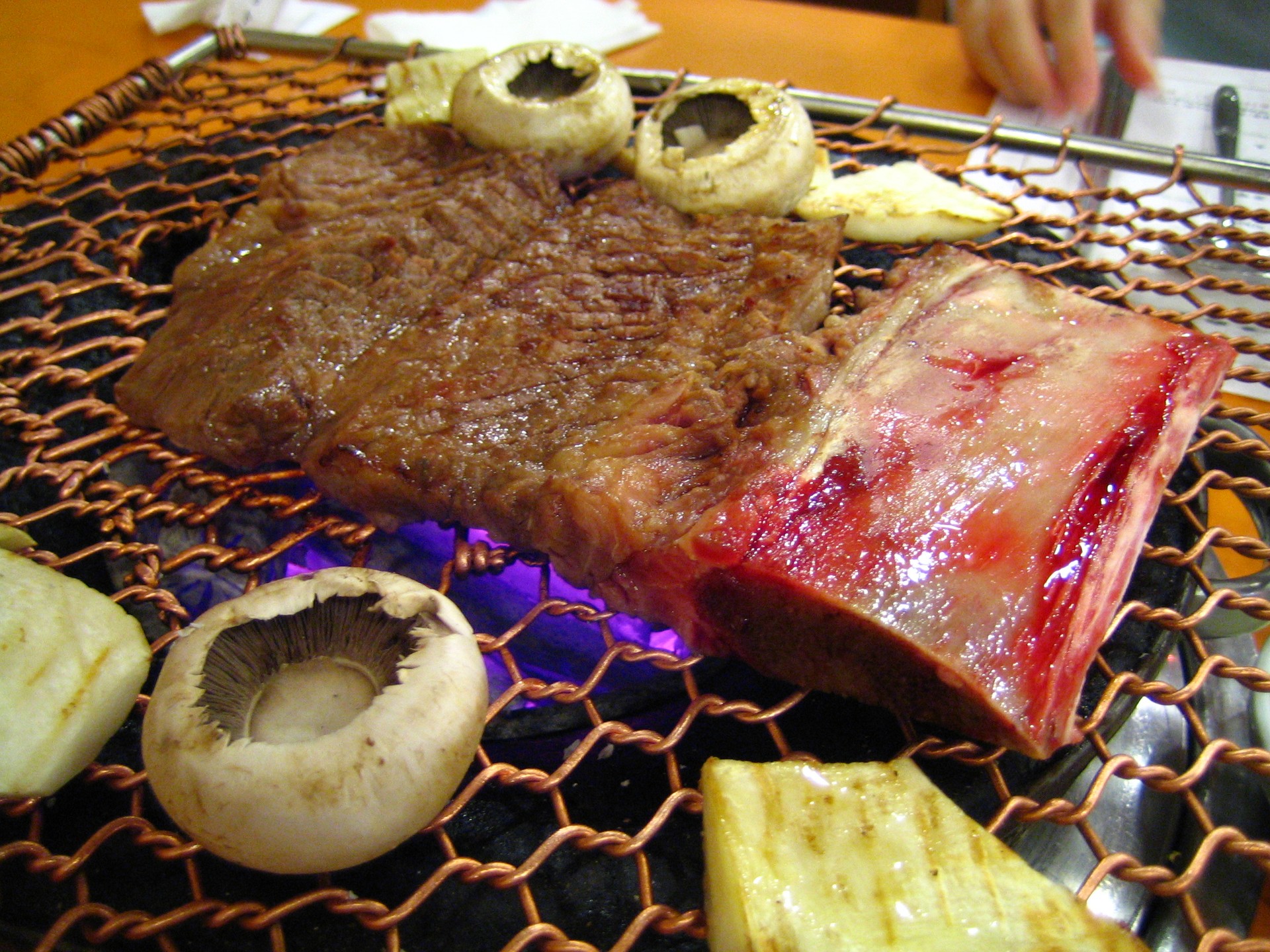
Bone-in butterfly-cut Suwon Wang-galbi short rib grilling with whole button mushrooms over red charcoal on a hand-woven copper mesh grate. · Photo: ayustety (CC BY-SA 2.0)
Suwon’s obsession with extra-large Wang-Galbi traces right back to King Jeongjo, who distributed draft cattle to farmers developing the new city and turned Suwon into one of Korea’s largest cattle markets. By the 1940s, diners near Paldalmun Market began butterfly-slicing massive bone-in beef short ribs, lightly curing them with grated Korean pear and garlic, and searing them over blazing charcoal on woven copper grates (guri-seoksoe). Pair glistening seared strips with crisp raw sliced onion and over a dozen complimentary banchan side dishes, then walk outside to see Paldalmun South Gate—Korea’s Treasure No. 402—standing floodlit in the middle of a modern city roundabout beneath Mount Paldal’s climbing stone walls.
View Author’s Original Field Note
紫銅網烤出來的肉汁焦香真的跟首爾市區不太一樣!店員把厚切大排骨剪開時肉質還帶著粉嫩,搭一點洋蔥絲就能解膩;吃飽走到圓環看打燈後的八達門南門,剛剛好消化完這頓大餐。
Interactive Location & Route Map
Many rural Asian landmarks don’t appear when searching English spellings in Google Maps. Click any numbered stop on the map below or tap the button above to open the exact latitude/longitude pin on your phone.
Frequently Asked Questions
How do I reach Suwon Hwaseong from Seoul, and where can I store overnight luggage?
From Seoul Station or Yongsan Station, take the KTX (30 mins) or Seoul Subway Line 1 Express (40 mins) to Suwon Station. Drop heavy bags inside the electronic lockers along Suwon Station’s B1 subway concourse, or ride Bus 11 or 13 from Stop 6 outside Exit 4 to the Hwaseong Haenggung Tourist Information Center for free manned bag storage before 18:00.
Is 1 day enough for Suwon Hwaseong, or what should I do on Day 2 if I stay overnight?
One full day comfortably covers the northern gates, Haenggung Palace, Banghwasuryujeong, Haengnidan-gil cafes, and Wang-galbi dinner. Staying overnight lets you tackle the steeper western ridge up to Mount Paldal’s Seojangdae Command Post at 08:30 before midday heat, ride the Hwaseong Tourist Trolley loop from Yeonmudae (6,000 KRW, closed Mondays) or shoot traditional bows at Yeonmudae (3,000 KRW / 10 arrows), and wrap up with fried galbi-glazed chicken on Suwon Chicken Street before afternoon trains back to Seoul.
Can solo travelers easily eat Suwon Wang-Galbi?
Most historic charcoal houses around Paldalmun and Yeonmudae strictly enforce a two-portion minimum order for raw or marinated short ribs (roughly 100,000–140,000 KRW total), though a single hungry diner willing to pay for two servings is usually seated outside peak weekend rushes. Otherwise, solo visitors enjoy galbi-seasoned fried chicken halves on Suwon Chicken Street or single-bowl galbitang beef rib soup at lunchtime.
How long does walking the entire 5.74 km fortress loop take?
Walking the entire 5.74-kilometer perimeter at a relaxed pace with photo stops takes 2.5 to 3.5 hours. If you run short on energy—especially before the steep Mount Paldal climb—board the dragon-headed Hwaseong Tourist Trolley (6,000 KRW, Yeonmudae circular loop, closed Mondays) during daytime hours.
Field Verification & Non-Sponsored Standards
This travel dispatch was researched exclusively through public transport (trains, local branch buses, ferries) and foot exploration. Uncharted Asia accepts zero commercial sponsorships, free stays, or sponsored meals. Timetables, fare gates, and mountain trail conditions are independently verified against physical operator timetables. Learn more in our Editorial Methodology.